
Spotlight on Our Faculty
Annmarie Carlton has been with AirUCI for the past four years, and right off the bat she brought her enormous energy to a number of new projects. She has a wide variety of research interests, and particularly intriguing is her new work on deep learning for multiphase chemistry.
Multiphase environmental organic chemistry deals with the physico-chemical transformations between gaseous, liquid, and solid matter on scales ranging from nanoseconds to millennia, from molecular to global scales. Artificial intelligence and machine learning lend themselves to chemical discovery in this area, and Annmarie is one of the leaders in this new endeavor as well.
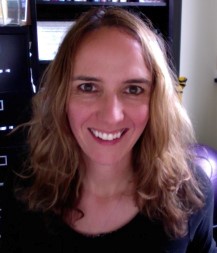 Upon graduation from Rutgers University, Annmarie worked as an inspector for Region 2 of the U.S. Environmental Protection Agency (EPA) in New York, visiting facilities and responding to disasters in New York, New Jersey, Puerto Rico, and the U.S. Virgin Islands. It was a tough job that required a lot determination and courage on Annmarie’s part as she was often dealing with people who were not very interested in following environmental regulations and were eager to avoid compliance inspections. For example, once she was performing an inspection in Brooklyn when the company would not let her in. She returned about 30 minutes later with Federal Marshals, only to find that everyone was gone and the building was on fire!
After earning her Ph.D. in 2006, she worked for the EPA's Office of Research and Development in Research Triangle Park, NC as a model developer for Community Multiscale Air Quality (CMAQ) model, which is used by the EPA for rulemaking and by the National Weather Service for air quality forecasting. She was largely responsible for adding chemistry in cloud droplets to CMAQ which was a critical improvement to the model.
She joined AirUCI in 2016 as an associate professor in the Chemistry Department and quickly rose to the level of a full professor. The hire of Annmarie was part of a High-Impact-Hiring initiative, which brought us a total of five new faculty with expertise in atmospheric chemistry. This High-Impact-Hiring initiative represented an unprecedented expansion, and it has propelled UCI to the leading position in the field — we now have the largest number of atmospheric chemists in a chemistry department!
Annmarie currently has several research projects underway. A partial list includes:
- In a grant from the National Science Foundation (NSF), she is studying the impacts of salts on organic partitioning to droplets, both experimentally in the lab and field and through modeling using CMAQ.
- With funding from the National Oceanic and Atmospheric Administration (NOAA) she is developing model formulations to better describe the fate and transport of organic compounds emitted to the atmosphere during fires.
- With collaborators in UCI’s Computer Science Department, Annmarie is helping develop artificial intelligence software to predict elementary reactions with support from the U.S. Department of Defense through the Army Research Office.
- With collaborators from the Department of Energy's Argonne National Laboratory, she is modeling aerosol impacts on short and long wave radiative fluxes in the Southeast U.S.
- NSF just awarded Annmarie and her collaborators use of their C-130 for the summer of 2022 in a project called "GOTHAAM" to investigate anthropogenic-biogenic-hydrologic interactions in the atmosphere.
More of her projects are described on her group’s Research page. On top of everything else, she is the UCI Chemistry Department's inaugural chair for Diversity, Equity, and Inclusion.
We are fortunate to have Annmarie and benefit from the boundless energy she brings to her projects and to the AirUCI team.
