
Spotlight on Faculty: Eric Saltzman
Fire and ice, balmy tropics and frigid poles — Eric Saltzman works the extremes. As a Distinguished Professor in UCI’s Department of Earth System Science, he has literally gone to the ends of the earth to further our understanding of the effects of climate change on our atmosphere and our oceans.
Eric and his team are interested in the global cycles of trace gases — where they come from, where they go, and how man’s activities and climate change influence their levels in the atmosphere. One focus of his work is understanding ocean emissions, a large but poorly understood flux of chemicals to the atmosphere. The Saltzman team develops trace gas detectors to detect ocean emissions from research ships and develops computer models to simulate gas exchange across the very dynamic air/sea interface. His team pioneered the real-time measurement of air/sea fluxes using chemical ionization mass spectrometry.
A second research theme is reconstructing past atmospheric composition using the air trapped in polar ice sheets. The bubbles trapped in polar ice cores from Greenland and Antarctica provide well-dated samples of the ancient atmosphere. The trace gases in these bubbles hold clues to how global biogeochemistry has changed since the last ice age, and how agriculture and industrialization changed our atmosphere. The team recently drilled an Antarctic ice core at the South Pole with ice ranging in age over the past 50,000 years.
Eric is particularly enthused about two ongoing projects, one involving fire and the other involving ice.
His team has made the first ice core measurements of acetylene with the goal of developing a global history of fire emissions. Wildfires are increasingly in the news and likely to grow in severity in coming decades with climate change. Acetylene turns out to be an ideal tracer for past fire emissions since fire is the only significant preindustrial source for this trace gas. The acetylene record will shed new light on the relationship between fire and climate on long time scales. 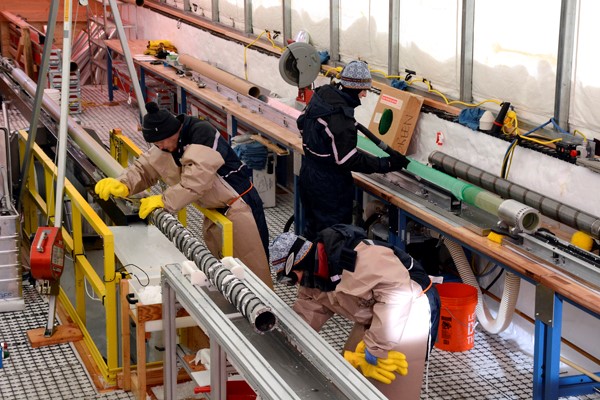 One key goal is to determine what global emissions were 125,000 years ago – the last time Earth was warmer than today. With funding from NSF, his team is currently analyzing acetylene in Antarctic and Greenland ice cores.
The other project focuses on hydrogen (H2) which is the third most abundant atmospheric trace gas (after CO2 and CH4). H2 is emitted from both natural and anthropogenic processes and, surprisingly, most of the H2 in the atmosphere is destroyed by microbes in soils. If the hydrogen economy becomes a reality and H2 becomes a major energy source, H2 emissions are likely to rise substantially. To date, we have no ice core records of paleoatmospheric H2 and know little about how atmospheric levels have changes in the past.
Working with scientists from NOAA, CSIRO, and Scripps, Eric’s team has reconstructed atmospheric H2 levels over the past century by analyzing air trapped in polar snow from Antarctica and Greenland. 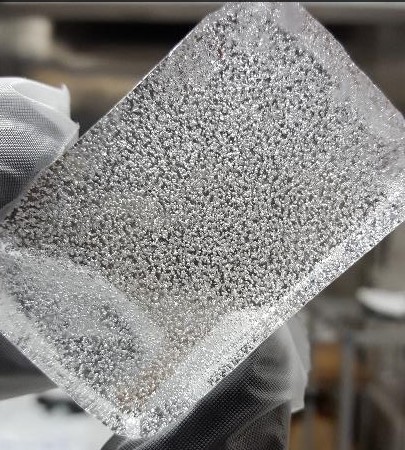 The data show that man's activity has dramatically increased atmospheric H2 levels over those of preindustrial levels. The next step is to develop the capability to make H2 measurements in ice core air bubbles, shown here, to see how atmospheric H2 changed during periods of rapid climate change in the past. Ice core records of H2 do not yet exist because the hydrogen molecule is so small that it diffuses rapidly through solid ice. As a result, the ice cores in our archive have all exchanged H2 with the modern atmosphere. A proposal is pending at NSF to drill a new Antarctic ice core specifically to measure H2.
Eric's collection of ice core samples is one of the most popular exhibits on tours of our AirUCI laboratories. Visitors of all kinds — school groups, scout troops, dignitaries, and the general public — are impressed when they hear of the efforts his team has gone to obtain these samples and the techniques used to analyze them. It takes a team of dedicated researchers to endure the long journeys and extreme conditions in order to collect ice core samples. Eric and his team have ample expertise for this task, and their work is widely recognized in the world of science as well as inspirational to students and other visitors.
